


Why Your Favourite Myths Are Not What You Think

Updated: Jun 3
Most of us think we know mythology. We don't. We know edited versions of it — filtered through centuries of translation, artistic interpretation, and cultural repetition until the original structure is barely recognisable underneath.
Take the apple in Eden. It never existed. The original Hebrew text doesn't specify any fruit at all. The apple crept in later, partly through a Latin accident — malus meaning both "apple" and "evil" — and was then cemented by Renaissance painters who needed something visually compelling to put in Eve's hand. Once the apple took hold, it flattened the whole story. The Eden narrative isn't really about a forbidden object. It's about boundary violation — knowledge claimed without sanctioned access. That's a much more interesting idea, and a much more transferable one.
This matters because the difference between surface similarity and structural similarity is everything when you're reading myth seriously.
The stories travel further than you'd think
Flood myths appear across dozens of unconnected cultures, and the temptation is to treat them as parallel invention — humans everywhere experiencing floods and building stories around them. But the details are too specific for that explanation to hold.
In both the Epic of Gilgamesh and Genesis, you find the same narrative sequence: a divine warning, a constructed vessel, the preservation of living things, a grounded landing, and — most strikingly — birds used to test for dry land. In Gilgamesh, the birds go out in the order dove, swallow, raven. In Genesis, it's raven first, then dove. Different editorial choices, same underlying system. That's not coincidence. That's transmission. Someone carried this story, and it spread.
Immortality isn't a gift — it's a supply chain
One of the most consistent patterns across world mythology is that divine immortality is never a fixed state. It's maintained, often precariously.
Greek gods require ambrosia. Norse gods depend on Iðunn's apples — when she's taken from Asgard, the gods visibly age and weaken. Indo-Iranian traditions centre ritual substances like Soma and Haoma as the source of vitality. Strip away the poetry and what you're left with is a surprisingly practical idea: divinity is a system under continuous pressure. Remove the input, and the system fails.
Genesis takes a completely different position. There's no dependency, no nutritional requirement, no supply chain keeping God functional. Immortality is withheld from humans not because it can't be sustained — but because access to it is being controlled. That's a different philosophical argument entirely. Not fragile divinity. Managed access.

Gods start human because humans build gods in their own image
Early gods across almost every tradition behave recognisably like people — reactive, emotional, negotiable, sometimes petty. That's not theological naivety. It's cognitive. Human brains are wired to detect agency in the world around them, to project intention onto things that affect us. Our earliest gods were, naturally, us at scale.
What's interesting is watching that change. The trajectory across most traditions moves from polytheism through henotheism toward monotheism, and then — once philosophy gets involved — toward something even more abstract. God stops being a character and becomes a concept: unchanging, emotionless, perfect, logically necessary. The old stories don't disappear. They get reinterpreted to fit the new framework. The anthropomorphic god becomes metaphor.
Why any of this still matters
Here's what usually gets missed: these structures didn't die. They adapted.
Humans still think in archetypes. We still organise behaviour around states and thresholds. We still use symbolic systems — consciously or not — to make decisions and build identity. Myth never went away. It just stopped announcing itself.
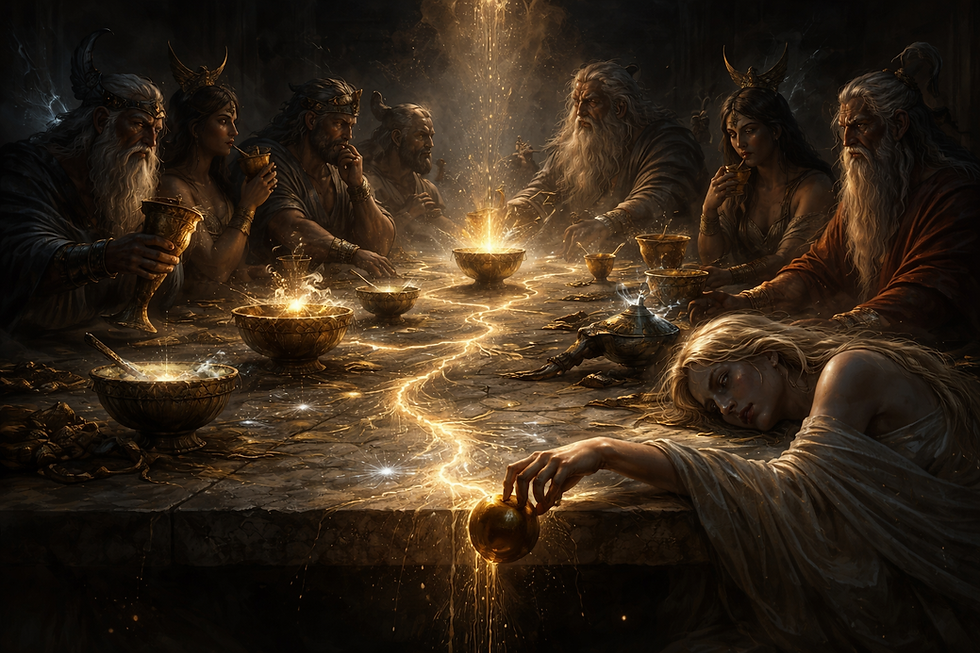
You can see this clearly in how powerful brands operate. The ones that last aren't selling a product. They're tapping into something older — a structure people already recognise without knowing why.
Pantheon Energy is built on exactly this logic. Rather than positioning energy as a single blunt output — more stimulation, more caffeine — the brand draws on what mythology actually encoded: the idea that different states of being require different kinds of power. Wisdom. Strength. Endurance. Recovery. These aren't marketing categories. They're mythic archetypes that have been organising human experience for thousands of years.
Where most energy drinks sell activation, Pantheon sells something more intentional — directed state control. That framing isn't new. It's ancient. Which is precisely why it works.
Across every culture and every era, the underlying pattern holds: humans build structures to manage uncertainty. Myths weren't primitive attempts at science. They were operating systems — tools for navigating chaos, defining limits, and understanding where power comes from and who controls it.
The language has changed. The systems haven't.
So the real question isn't whether myth is still relevant. It's simpler than that:
Which myths are you currently running your life on — and are you doing it consciously?


Comments